Understanding the Principles of TGA: A Quick Guide
Thermogravimetric Analysis (TGA) is an analytical technique that measures the change in a substance's mass as a function of temperature or time under a controlled program. This method detects physical phenomena (such as melting, sublimation, and adsorption) and chemical reactions (including dehydration, decomposition, oxidation, and reduction) by recording mass loss events on a Thermogravimetric (TG) curve. On this curve, mass is plotted on the vertical axis (decreasing downwards) against temperature or time on the horizontal axis. TGA instruments typically consist of a precision balance, a furnace, a temperature control system, and a data recorder. The core measurement mechanisms rely on either the deflection method, which records beam inclination directly, or the null-point method, which uses an electromagnetic coil to counterbalance mass changes, converting the required restoring current into a precise mass-loss profile.
Principles of Thermogravimetric Analysis (TGA)
A Thermogravimetric Analyzer (TGA) is an instrument that utilizes thermogravimetry to detect the relationship between a substance's temperature and its mass. Thermogravimetry involves measuring the change in a substance's mass as a function of temperature (or time) under a controlled temperature program. When the substance under test undergoes sublimation, vaporization, gas decomposition, or loss of water of crystallization during heating, its mass changes. Consequently, the thermogravimetric curve deviates from a straight line and shows a decline. By analyzing the thermogravimetric curve, one can determine the temperature at which the substance undergoes changes. Furthermore, based on the weight loss, the quantity of the substance lost can be calculated (e.g., the water of crystallization in CuSO4⋅5H2OCuSO4⋅5H2O ). From the thermogravimetric curve, we can observe that the 5 water molecules of crystallization in CuSO4⋅5H2O are removed in three distinct steps. TGA experiments help in studying changes in crystal properties, such as physical phenomena like melting, evaporation, sublimation, and adsorption. They also aid in studying chemical phenomena such as dehydration, dissociation, oxidation, and reduction. Thermogravimetric analysis is generally classified into two categories: dynamic (heating) and static (isothermal). The curve obtained from a thermogravimetric experiment is called a Thermogravimetric (TG) curve. On a TG curve, the vertical axis represents mass (decreasing from top to bottom), and the horizontal axis represents temperature (or time), increasing from left to right.
Working Principle of the Analyzer
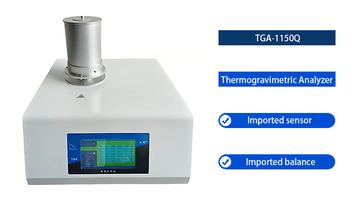
Let us now take a look at the working principle of the Thermogravimetric Analyzer. The analyzer mainly consists of a precision balance, a furnace, a programmed temperature control system, and a recording system. There are two common measurement principles: the deflection method and the null-point (zero) method.
- Deflection Method: This method relies on the proportional relationship between the inclination of the balance beam and the change in mass. The inclination is detected using devices such as a differential transformer and is automatically recorded.
- Null-Point Method: This method uses a differential transformer or optical methods to measure the inclination of the balance beam. It then adjusts the current in a coil installed within the balance system and a magnetic field to rotate the coil and restore the balance beam to its horizontal position (the "null" point).
Since the force applied by the coil's rotation is proportional to the mass change, and this force is proportional to the current in the coil, measuring and recording the change in current allows for the derivation of the mass change curve.
Latest News

CPC News 2026W23
Jun 05, 2026 • Industry Observation Team • Internet
CPC News 2026W22
Jun 03, 2026 • Industry Observation Team • Internet

Intelligently Shaping Tomorrow, Advancing Together into a New Era — CHINAPLAS 2026
Apr 08, 2026 • AdsaleCPRJ
Popular Articles
Principles and Features of the Rubber Carbon Black Dispersion Tester: A Complete Guide.
Mar 23, 2026 • leon
Intelligently Shaping Tomorrow, Advancing Together into a New Era — CHINAPLAS 2026
Apr 08, 2026 • AdsaleCPRJ
CPC News 2026W23
Jun 05, 2026 • Industry Observation Team • Internet
Back