Principles and Features of the Rubber Carbon Black Dispersion Tester: A Complete Guide.
The Rubber Carbon Black Dispersion Tester is a specialized instrument designed in accordance with standard GB-6030 and international standard ISO-11345. Its testing principle is as follows:
When rubber (vulcanized rubber or masterbatch) is cut, the undispersed carbon black aggregates, which possess higher hardness relative to the surrounding rubber matrix, cause deviations in the cutting path. This results in a rough and uneven cut surface. Furthermore, the larger the undispersed carbon black aggregates, the greater the surface roughness.
Light is projected onto the cut surface at a specific angle. The surface conditions are magnified, directly displayed on the screen, and recorded as digital images.
These digital images are processed by a computer. Based on the size and frequency of the protruding clusters on the cut surface, the system automatically evaluates the dispersion rating (Automatic Grading Function) in accordance with relevant standards to characterize the degree of carbon black dispersion in the rubber. Alternatively, the images can be directly compared with standard images stored in the instrument or with user-defined standards (Image Comparison Function).
The Rubber Carbon Black Dispersion Tester is a specialized instrument designed in accordance with standard GB-6030 and international standard ISO-11345. Its testing principle is as follows:
When rubber (vulcanized rubber or masterbatch) is cut, the undispersed carbon black aggregates, which possess higher hardness relative to the surrounding rubber matrix, cause deviations in the cutting path. This results in a rough and uneven cut surface. Furthermore, the larger the undispersed carbon black aggregates, the greater the surface roughness.
Light is projected onto the cut surface at a specific angle. The surface conditions are magnified, directly displayed on the screen, and recorded as digital images.
These digital images are processed by a computer. Based on the size and frequency of the protruding clusters on the cut surface, the system automatically evaluates the dispersion rating (Automatic Grading Function) in accordance with relevant standards to characterize the degree of carbon black dispersion in the rubber. Alternatively, the images can be directly compared with standard images stored in the instrument or with user-defined standards (Image Comparison Function).
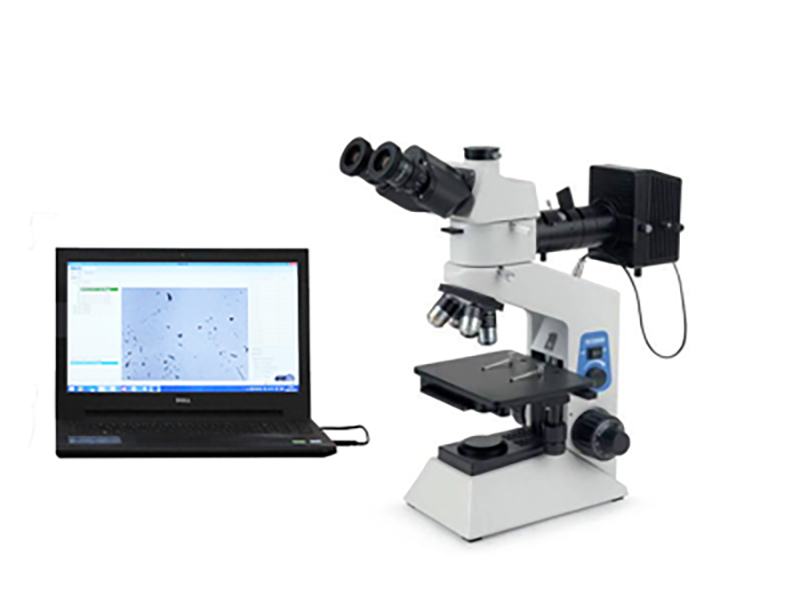
Having understood the testing principle of the Rubber Carbon Black Dispersion Tester from the content above, let’s now explore its key features.
- Automated Platform: Equipped with an optional automatic platform to significantly enhance the level of automation in detection.
- High Precision: Utilizes professional image analysis methods, ensuring high detection accuracy and traceable measurement precision.
- Broad Compatibility: The software is compatible with various mainstream operating systems, including Windows 7 and Windows XP.
- Modular Design: Adopts an advanced modular design concept, featuring functions such as automatic grading, image comparison, particle size analysis, result storage, and reporting.
- Comprehensive Parameters: Offers extensive measurement parameters covering both scale (equivalent diameter, major/minor axis, area, perimeter, etc.) and morphology (circularity, rectangularity, aspect ratio, etc.) of carbon black agglomerates, satisfying diverse image processing needs.
- Tailored Processing: Features dedicated processing programs for different user product series. This ensures accurate extraction of carbon black components and reliable test results, with the entire process from image acquisition to result output being fully automated.
- Flexible Reporting: Comes with a flexible data analysis and reporting system. Based on standard statistical templates for carbon black dispersion, it fully accommodates users' personalized reporting requirements.
- Integrated System: Utilizes an advanced modular design that integrates computer hardware, optics, electronics, digital conversion, and detection software. It combines functions like automatic grading, image comparison, particle size analysis, result storage, and report printing.
- Significance: This instrument is of great significance for rapidly and accurately assessing carbon black dispersion. It aids in predicting physical properties, controlling mixing processes, ensuring product quality, improving production efficiency, saving energy, and reducing costs.
Latest News

CPC News 2026W23
Jun 05, 2026 • Industry Observation Team • Internet
CPC News 2026W22
Jun 03, 2026 • Industry Observation Team • Internet
Intelligently Shaping Tomorrow, Advancing Together into a New Era — CHINAPLAS 2026
Apr 08, 2026 • AdsaleCPRJ
Popular Articles
Intelligently Shaping Tomorrow, Advancing Together into a New Era — CHINAPLAS 2026
Apr 08, 2026 • AdsaleCPRJ
CPC News 2026W23
Jun 05, 2026 • Industry Observation Team • Internet
CPC News 2026W22
Jun 03, 2026 • Industry Observation Team • Internet
Related Products
TGA-1150Q / TGA-1450Q
Updated: Apr 08, 2026
CBD-500P Carbon Black Dispersion Tester
Updated: Apr 03, 2026
Back