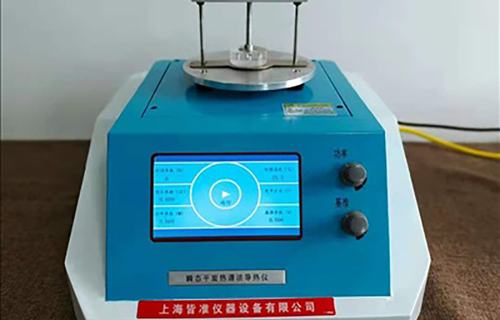
How the Transient Plane Source (TPS) method differs from other thermal conductivity analyzers
Differences between the Transient Plane Source (TPS) method and other thermal conductivity measurement techniques
Research on thermally conductive materials in universities is characterized by a high degree of material diversity:
In terms of conductivity range: It encompasses everything from thermal insulators to highly conductive materials.
In terms of physical form: It covers solids, liquids, powders, and even gases.
Since students work on a wide variety of thesis topics, researchers inevitably encounter all these material types. However, since most other thermal conductivity analyzers on the market are often limited to measuring only one specific form of material, a single instrument is rarely sufficient to address the diverse needs of all student projects.
Detail
| Different Method | Transient Plane Source (TPS) | Laser Flash | Hot Wire | Plate Method |
|---|---|---|---|---|
| Measurement Method | Non-steady state | Non-steady state | Non-steady state | Steady state |
| Properties Measured | Directly obtains thermal conductivity and thermal diffusivity | Directly obtains thermal diffusivity and specific heat; thermal conductivity is calculated by inputting sample density | Directly obtains thermal conductivity | Directly obtains thermal conductivity |
| Applicable Range | Solids, liquids, powders, pastes, gels, particles | Solids | Solids, liquids | Solids |
| Sample Preparation | No special requirements, simple sample preparation | Complex sample preparation | Simple sample preparation, but specific requirements | Large sample dimensions required |
| Measurement Accuracy | ±3%, best up to ±0.5% | best up to ±10% | best up to ±3% | best up to ±3% |
| Physical Model | Plane heat source contact measurement, requires good finite contact | Non-contact heat source | Line heat source, requires good contact for line model | Contact heat source, requires good surface contact |
| Thermal Conductivity Range [W/(m*k)] | 0.005-300 | 10-500 | 0.005-10 | 0.005-5 |
| Measurement Time | 5-160s | A few minutes | Tens of minutes | Several hours |
Research on thermally conductive materials in universities often features material diversity: whether in terms of thermal conductivity range: it includes both insulating materials and thermally conductive materials, or in terms of material form: solids, liquids, powders, and even gases. Given that different students choose different thesis topics, they will inevitably encounter all these types of materials. However, since other models of thermal conductivity analyzers on the market often can only measure materials of a single form, a single instrument would find it difficult to address the diverse needs of all student projects. In addition, the fast testing speed and simple sample preparation of this thermal conductivity analyzer are also very important factors considered by universities.
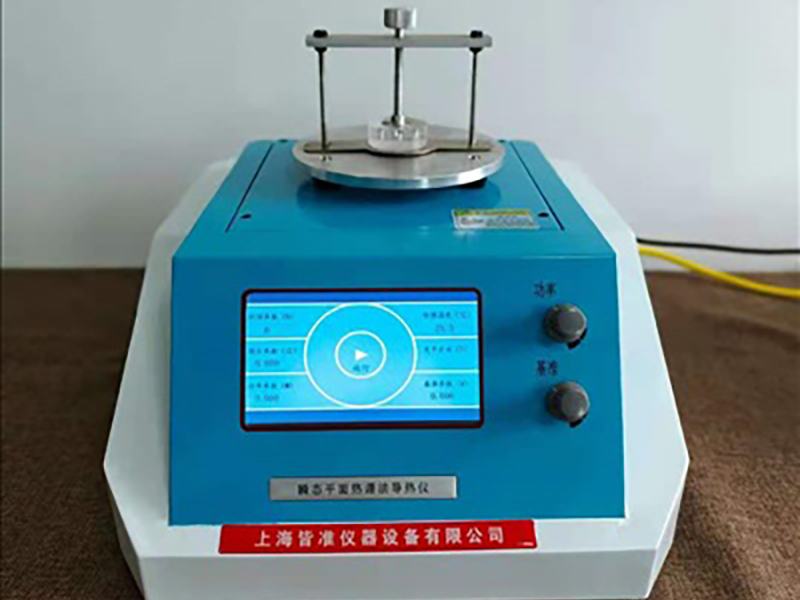
Technical Specifications:
- Test Range: 0.005 - 300 W/(m*K)
- Measurement Temperature Range: Room temperature - 130°C
- Probe Diameter: Probe No. 1: 7.5mm; Probe No. 2: 15mm
- Accuracy: ±3%
- Repeatability Error: ≤3%
- Measurement Time: 5~160 seconds
- Power Supply: AC 220V
- Total Power: <500W
- Sample Temperature Rise: <15°C
- Test Sample Power: Power of Probe No. 1 is 0
- Sample Specifications:
- Single sample size for Probe No. 1: 15*15*3.75mm
- Single sample size for Probe No. 2: 30*30*7.5mm
Note: Probe No. 1 is used for measuring thin, low-conductivity materials. If the sample surface is smooth, flat, and adhesive, samples can be stacked.
Machine Dimensions: 50*41*20
Latest Cases
Determination of carbon black dispersion in plastic pipes
Mar 23, 2026 143
Measurement of carbon black content in rubber using TGA
Mar 23, 2026 Qingdao University of Technology 105
Determination of Curing Reaction Heat and Glass Transition Temperature of Thermosetting Resins
Mar 18, 2026 173
Popular Cases
Determination of Curing Reaction Heat and Glass Transition Temperature of Thermosetting Resins
Mar 18, 2026 173
Determination of carbon black dispersion in plastic pipes
Mar 23, 2026 143
Measurement of carbon black content in rubber using TGA
Mar 23, 2026 Qingdao University of Technology 105
Back